The ARRL Solar Update
Weekly Highlights and Forecast, August 17, 2026, by NOAA Space Weather Prediction Center:
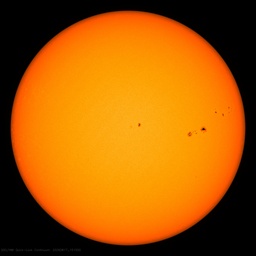
Solar activity ranged from very low to low levels throughout the
period. No R1 (Minor) or greater events were observed. The largest
flare was a C8.2/Sn at 16/1928 UTC from Region 4506. An associated
CME was observed in LASCO C2 imagery following the C8.2 flare, but
analysis is ongoing in order to determine any Earth-directed component.
Other activity included the lift-off of av large filament near S16E22
at 14/0332 UTC which produced a CME that is expected to arrive on 17-18 Aug.
Geomagnetic field activity is expected to reach active levels on
17-18 Aug due to the anticipated arrival of a CME that left the Sun
on 14 Aug. Active conditions are expected again on 21-22 Aug and 04
Sep due to the influences of a CH HSS. Quiet and quiet to unsettled
conditions are expected to prevail throughout the remainder of the
outlook period.
Weekly Commentary on the Sun, the Magnetosphere, and the Earth's Ionosphere, August 13, 2026, by F. K. Janda, OK1HH:
It appears that solar activity will remain relatively low for a few more days before mid-August; however, it is more likely that July s surprise will repeat itself and solar activity will increase after a few days. This would be a more favorable scenario for possible future developments in the Earth s ionosphere. Although the sporadic E layer often plays a significant role in the ionosphere at mid-latitudes, its season will gradually come to an end.
Solar activity will rise in the second half of the month, while geomagnetic activity is expected to decrease on average. It is hard to imagine a better scenario for future developments, and it appears that this one will at least partially come to pass.
The current solar report from Dr. Tamitha Skov, WX6SWW, can be found
on YouTube at, https://www.youtube.com/watch?v=7od5srHvDsw&t=3s .
The Predicted Planetary A Index for August 14 to August 20 is 5, 5, 5, 15, 12, 20, and 8 with a mean of 10. The Predicted Planetary K Index is 2, 2, 2, 4, 4, 5, and 3 with a mean of 3.1. Predicted 10.7 centimeter flux is 95, 95, 95, 100, 105, 105, and 105 with a mean of 100.
For more information concerning shortwave radio propagation, see
http://www.arrl.org/propagation and the ARRL Technical Information
Service web page at, http://arrl.org/propagation-of-rf-signals. For
an explanation of numbers used in this bulletin, see
http://arrl.org/the-sun-the-earth-the-ionosphere . Information and
tutorials on propagation can be found at, http://k9la.us/ .
Also, check this:
https://bit.ly/3Rc8Njt
"Understanding Solar Indices" from September 2002 QST.
Photo Gallery
-
 Image courtesy of...
Back


